
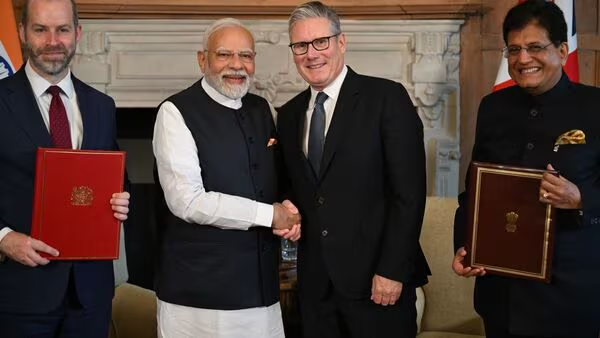
India-UK Free Trade Agreement 2025 Signed
Strategic Boost for Youth, MSMEs, and Farmers – CLAT Current Affairs 2026
GK & Current Affairs for CLAT | CLAT Current Affairs 2026
Powered by CLAT Gurukul – Best online coaching for CLAT
Why in News?
On July 24, 2025, India and the United Kingdom officially signed a much-awaited Comprehensive Economic and Trade Agreement (CETA) during Prime Minister Narendra Modi’s meeting with British PM Keir Starmer at Chequers, UK. The deal is aimed at promoting bilateral trade, enhancing investment, and creating new market opportunities for sectors like MSMEs, farmers, fishermen, and youth employment. This agreement is part of India’s broader effort to deepen its trade engagement post-COVID and post-Brexit.
Given its economic and strategic significance, the CETA is crucial for understanding India’s foreign trade policy, international economic diplomacy, and legal framework of trade agreements, making it essential content for CLAT Current Affairs 2026.
Introduction
The India-UK Comprehensive Economic and Trade Agreement (CETA) represents a new phase in bilateral relations between two major democracies with colonial-era ties and modern economic interdependence. This trade pact is being seen as a landmark initiative that promises to open new export opportunities, boost technology transfers, ensure regulatory alignment, and solidify geopolitical cooperation between New Delhi and London.
The agreement has been finalized at a time when:
- India is engaging with several nations for bilateral trade deals (including US, EU).
- Global trade systems face rising protectionism, tariff wars, and supply chain reconfigurations.
- Brexit created a vacuum in UK’s global trade presence that India is helping to fill.
For CLAT aspirants, such a trade deal presents a perfect mix of international law, constitutional provisions (Article 253), trade regulation, and economic policy-making—all important themes in legal reasoning and current affairs sections.
Point-wise Summary
🔹 1. What is the India-UK CETA?
- A bilateral free trade agreement (FTA) signed on July 24, 2025.
- Finalized between Indian PM Narendra Modi and UK PM Keir Starmer at Chequers.
- Described as a deal that promotes not only economic partnership but “shared prosperity”.
🔹 2. Context of the Agreement
- Comes amid global volatility in trade—particularly:
- Ongoing tariff tensions between the US and other countries.
- Rising protectionism and slowing WTO reforms.
- Brexit made it imperative for the UK to seek new bilateral partnerships.
- India is simultaneously negotiating trade pacts with the EU and the US.
🔹 3. Benefits for India Highlighted by PM Modi
- The deal is projected to benefit:
- Youth – through job creation and innovation partnerships.
- Farmers – by allowing easier agricultural exports.
- Fishermen – with new quotas and standards for seafood trade.
- MSMEs – with reduced tariffs, improved access to UK markets.
🔹 4. Chequers: Symbolic Signing Venue
- The historic Chequers estate was chosen as the site for the signing ceremony.
- This location underscores the diplomatic importance of the partnership.
- Indian Commerce Minister Piyush Goyal and UK Business Secretary Jonathan Reynolds were also present.
🔹 5. Trade and Tariff Reductions
- The agreement reduces or eliminates tariffs on a wide range of goods and services.
- Includes provisions for:
- Duty-free access to specific commodities.
- Reduced non-tariff barriers through regulatory cooperation.
- Customs harmonization and digital trade facilitation.
🔹 6. Strategic & Political Messaging
- India called the agreement “a template” for future pacts with other nations.
- May influence the India-US trade agreement currently under negotiation.
- Reaffirms India’s commitment to rules-based global trade in contrast to unilateralism.
🔹 7. Multisectoral Approach
- The agreement covers:
- Goods and services
- Intellectual property
- Digital trade
- Financial services
- Green technology cooperation
- Aims to promote climate-resilient trade and carbon-neutral technologies.
🔹 8. Political Consensus & Domestic Alignment
- The signing reflects bipartisan support for trade diplomacy in India and the UK.
- Comes amid broader domestic reforms in India (e.g., Production-Linked Incentive schemes).
- Could boost confidence among foreign investors and Indian exporters.
🔹 9. India’s Global Economic Positioning
- India aims to establish itself as:
- A reliable trade partner for Western economies.
- A manufacturing and export hub under “Make in India for the World”.
- A promoter of economic multilateralism amid shifting global alliances.
🔹 10. Future Expectations
- The CETA is expected to:
- Boost trade volume between India and the UK significantly by 2030.
- Support India’s MSME sector through better market access.
- Create a model for sustainable, inclusive, and tech-driven growth.
Explanation of Key Terms (Glossary)
Term | Explanation |
FTA (Free Trade Agreement) | A treaty between two or more countries to reduce barriers such as tariffs and quotas for mutual trade benefits. |
CETA | Comprehensive Economic and Trade Agreement – bilateral trade deal signed between India and the UK in July 2025. |
MSME | Micro, Small, and Medium Enterprises – backbone of Indian manufacturing and export industries. |
Chequers | Official country residence of the UK Prime Minister, symbolizing high-level diplomacy. |
Reciprocal Tariffs | Tariffs imposed in response to similar tariffs by the other trading country. |
Shared Prosperity | A concept of economic growth that benefits all segments of the population equitably. |
Relevance for CLAT 2026 Aspirants
Legal Reasoning
- The deal is based on international economic law, a relevant theme in legal reasoning questions.
- May involve discussions on:
- Treaty powers under Article 253 of the Constitution,
- Role of Commerce Ministry and Parliament in ratifying trade deals,
- Dispute settlement mechanisms under FTAs.
Current Affairs
- A high-potential topic for:
- Passage-based MCQs in CLAT 2026.
- Essay topics on India’s foreign policy, economic diplomacy, and trade law.
- Can also be tested in comprehension-based questions around India’s economic strategy.
GK/Static Law Integration
- Can be linked to:
- WTO framework
- India’s bilateral vs multilateral trade strategy
- Impact of Brexit on global trade alignments
Conclusion
The signing of the India-UK Comprehensive Economic and Trade Agreement 2025 is a diplomatic and economic milestone. Beyond reducing tariffs, it promotes inclusive growth, regulatory alignment, and shared technological advancement. For India, it opens the doors to enhanced cooperation with developed nations and sets the stage for more ambitious trade negotiations with the US and the EU.
For CLAT 2026 aspirants, this event offers a multidimensional understanding of law, economics, diplomacy, and institutional governance, making it a must-study for exams and future legal practice in trade and policy domains.
This Blog is Powered by CLAT Gurukul — India’s Leading Law Entrance Prep Platform
At CLAT Gurukul, we believe in empowering future legal minds with the right blend of knowledge, strategy, and mentorship. This blog is a reflection of our commitment to quality content that not only helps aspirants stay updated but also sharpens their conceptual clarity.
Why CLAT Gurukul?
- Personalized Mentorship by Top Legal Educators
- Comprehensive Study Materials & Legal Updates
- Daily Practice Sets, Mocks & Performance Tracking
- Result-Oriented Strategy for CLAT, AILET, and CUET
Whether you’re reading this article to deepen your understanding or to stay ahead in your exam prep — you’re already one step closer with CLAT Gurukul by your side.
Join thousands of successful aspirants who trusted CLAT Gurukul and cracked India’s top law entrance exams.
Visit https://www.youtube.com/@CLATGurukul/shorts to learn more or speak to our experts now!
Note from CLAT Gurukul
At CLAT Gurukul, we are committed to providing free CLAT study material, including CLAT current affairs, legal reasoning practice sets, general knowledge updates, logical reasoning questions, English comprehension exercises, and more — all curated by top mentors.
Our blog section is regularly updated with high-quality CLAT content tailored to match the evolving pattern of the CLAT UG exam. Whether you’re looking for CLAT 2026 current affairs, CLAT legal reasoning passages, or mock practice sets, we have you covered.
We believe in open-access learning and will continue to publish free CLAT preparation resources to help serious aspirants succeed.
Explore more free content under categories like:
Best online coaching for CLAT, CLAT current affairs, CLAT GK updates, CLAT legal updates, CLAT logical reasoning, and CLAT English preparation.
For structured learning, daily mocks, and expert mentorship, visit https://www.youtube.com/@CLATGurukul/shorts — the Best CLAT Coaching in Patna and India’s most trusted platform for CLAT online coaching.